
The nascent era of Initial Coin Offerings (ICOs) in 2017 promised groundbreaking financial innovation, yet for every legitimate attempt at decentralized technology, there existed sophisticated schemes built solely on deceit. Few scams define the perils of this period more clearly than Centra Tech, an alleged cryptocurrency firm whose founders successfully fleeced investors out of millions through an elaborate web of fabrications, demonstrating how easy it is for high-tech promises to mask old-school securities fraud.
SCAM MECHANISM
The Centra Tech scheme was not a simple rug pull—it was a calculated securities fraud built upon material misrepresentations and omissions designed specifically to solicit investment. The modus operandi relied heavily on manufacturing an illusion of legitimacy, stability, and proprietary cutting-edge technology that simply did not exist.
The trio of co-founders—Sohrab Sharma (also known as “Sam Sharma”), Robert Farkas, and Raymond Trapani—executed the fraud primarily by disseminating false claims across marketing platforms. The supposed foundation of Centra Tech was a set of crypto-based financial products, most notably a debit card designed to allow users to pay for goods and services using cryptocurrencies like Bitcoin or Ether. They also teased the development of an online marketplace called cBay. Critically, the company claimed that investors would need to own the Centra Tech tokens (CTR) to utilize these forthcoming, yet undeveloped, products.
The core deception lay in the fabrication of essential business relationships and personnel. Centra Tech falsely claimed to have secured major partnerships with reputable credit card companies. Furthermore, the founders created phony founder biographies to bolster their perceived expertise and trustworthiness. These biographical misrepresentations and false partnership claims were central to luring investors.
In a textbook case of bad actors leaving a clear paper trail, internal text messages later revealed the conspirators’ awareness and intent regarding the deception. When a large financial institution demanded that Centra Tech cease-and-desist using its name in marketing materials, Sharma texted Farkas and Trapani advising them to “get that st removed everywhere and blame freelancers lol”. In another brazen instance, Trapani texted Sharma asking to “cook up” fake documents specifically to secure the listing of the CTR Tokens on a major exchange, to which Sharma replied: “Don’t text me that st lol. Delete”. Beyond these foundational lies, Centra Tech was also involved in actively manipulating the market price of the Centra Tokens.
This mechanism of deploying false claims about products, relationships with credible financial institutions, and the credentials of its leadership highlights the operation as a meticulously orchestrated fraud, transforming the unregistered Initial Coin Offering (ICO) into a vehicle for illicit fundraising.

CASE SUMMARY
Centra Tech, based in Miami, promised a revolution in how cryptocurrency holders would transact in the real world. From July 2017 through September 2017, the company held an ICO, offering its Centra Tokens (CTR) to the public in exchange for cryptocurrency, netting the founders an estimated $25 million to over $32 million.
A significant catalyst for the ICO’s success was the involvement of high-profile celebrities. The Centra Tech offering was heavily endorsed by boxing superstar Floyd Mayweather and music producer DJ Khaled. Khaled promoted the offer on social media, calling it a “Game changer,” while Mayweather, referring to himself as “Floyd Crypto Mayweather,” urged his millions of followers to invest, claiming, “I got mine…”. These promotions lent an air of credibility to an enterprise that the SEC later alleged was built on a false impression of “viable, cutting-edge technology”.
However, the promises of crypto-linked debit cards and revolutionary technology never materialized. The enterprise crumbled when federal authorities, including the Securities and Exchange Commission (SEC), swooped in, recognizing that the ICO was simply a vehicle for fraud. The collapse led to the arrest of the three owners—Sohrab Sharma, Robert Farkas, and Raymond Trapani—on charges of fraud.
WARNING SIGNS (RED FLAGS)
For the general public interested in cryptocurrency investments, the Centra Tech case provides a detailed checklist of warnings that, in retrospect, signaled a fraudulent enterprise. The head of the SEC’s cyber unit, Robert A. Cohen, urged investors to “exercise caution about investments in digital assets, especially when they are marketed with claims that seem too good to be true”.
The key red flags present in the Centra Tech ICO were:
- Celebrity Endorsements Without Disclosure
- Both Floyd Mayweather and DJ Khaled were paid substantial sums—$100,000 and $50,000, respectively—to promote the Centra Tech ICO.
- Crucially, the celebrities failed to disclose these payments to their followers, making the promotions appear to be unbiased investment advice rather than paid endorsements.
- Investors should be deeply skeptical of investment advice posted to social media, recognizing that influencers are often paid promoters, not licensed investment professionals.
- Fabricated Partnerships and Biographies
- Centra Tech claimed associations with major, credible financial institutions that immediately began issuing cease-and-desist letters.
- The co-founders relied on false or exaggerated professional backgrounds and résumés. Any project should have easily verifiable principals and confirmed business relationships.
- Unregistered Securities Offering
- The ICO was not registered with the Securities and Exchange Commission (SEC).
- The tokens (CTR) were ultimately found by a U.S. District Court magistrate judge to meet the criteria of an investment contract under the Howey test, meaning they were legally considered securities. The token met the criteria because investors provided an investment of money (in the form of crypto like Bitcoin or Ether), in a common enterprise, with the expectation of profits to come solely from the efforts of the defendants.
- Success Dependent on Founders’ Efforts
- The viability and potential profit of the Centra Tokens were entirely dependent on the efforts, actions, and claimed product development of the Centra Tech founders. This lack of genuine decentralization and the necessity of management effort were fundamental elements that made the token legally recognizable as a security under the Howey standard.

CONSEQUENCES & LEGAL STATUS
The legal fallout from the Centra Tech scam was extensive, leading to multiple criminal convictions, significant forfeitures, and landmark decisions regarding cryptocurrency classification.
- Criminal Charges and Sentencing: The founders were indicted on charges including securities fraud, wire fraud, and mail fraud.
- Sohrab Sharma: Sharma, who pled guilty to conspiring to commit securities fraud, wire fraud, and mail fraud, was sentenced to eight years in jail. He was also ordered to serve three years of supervised release and was hit with a $20,000 fine, alongside a massive forfeiture order of $36,088,960.
- Robert Farkas: Farkas received a sentence of one year and one day in prison. He also faced three years of supervised release and was ordered to forfeit $347,062, including a Rolex watch purchased with the scam’s proceeds.
- Raymond Trapani and Cooperation: Raymond Trapani, who the SEC once labeled the “mastermind”, faced charges where three out of four counts carried a maximum sentence of 20 years. While some founders received prison time, one former Centra Tech principal was later allowed to avoid prison entirely due to his “extraordinary” cooperation with Manhattan federal prosecutors, crediting his decision to plead guilty.
- Investor Recovery: The U.S. Marshals Service seized cryptocurrency, specifically ether, from Centra Tech, which was subsequently sold for approximately $33.4 million.
- Civil Litigation Hurdles: Not all investors found easy recourse. A proposed class-action lawsuit filed by investors in Florida seeking restitution was denied certification by U.S. District Judge Robert N. Scola, Jr.. The denial stemmed from the court’s belief that the investors waited too long—18 months after the original claim and six months after the amended complaint—to file the certification bid, suggesting the delay may have been deliberate to avoid opposition.
- The Celebrity Fine: Boxer Floyd Mayweather and music producer DJ Khaled were not implicated in the criminal fraud but were charged and fined by the SEC for unlawfully touting the ICO. They neither admitted nor denied the charges. Mayweather paid $614,775, and Khaled paid $150,275, combining for a total of $767,500 in fines and penalties. They also agreed to temporary bans on promoting digital securities.
- Legal Precedent: A U.S. District Court magistrate judge delivered a significant legal conclusion in June 2018, finding that the Centra Tech token was indeed a security under federal law. Applying the Howey test, the court determined that the ICO was an unregistered offering and sale of securities because the investors were putting money into a common enterprise with the expectation of profits derived primarily from the efforts of the promoters (the Centra Tech founders). This finding affirmed the basis for the SEC’s regulatory and enforcement actions against the fraudulent ICO.
WRITER’S COMMENTARY
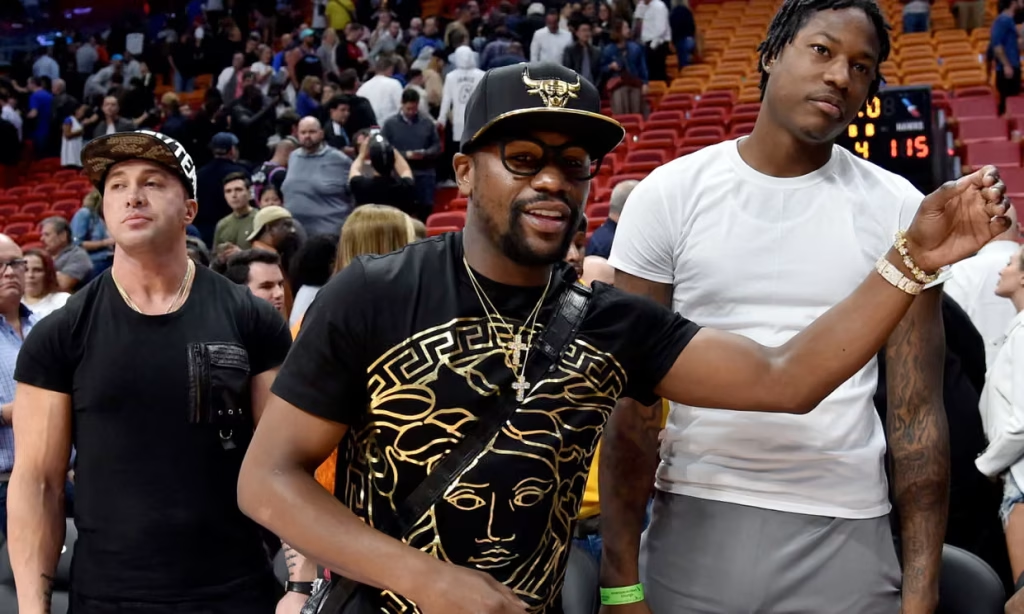
The Centra Tech fraud provides a timeless lesson that the success of a scam rarely relies on technical sophistication, but rather on exploiting human psychology—specifically, the fear of missing out (FOMO) and the misplaced trust in authority. The core cause of Centra Tech’s multi-million dollar success was the masterful use of fabricated authority coupled with celebrity amplification. In the chaotic 2017 ICO market, investors sought external validation where technical due diligence failed. Centra Tech shrewdly provided this validation via two vectors: manufactured institutional trust (fake credit card partnerships and professional résumés) and genuine star power (Mayweather and Khaled).
The founders understood that the association with an undefeated boxing icon and a celebrated music producer would override critical thinking for many retail investors. When a seemingly legitimate celebrity promotes an investment, the line between an unbiased recommendation and a paid advertisement blurs, particularly when that payment is concealed. This manipulation of celebrity influence, combined with a highly convincing (though entirely fake) backstory involving major financial players, enabled the scheme to transcend typical fraud and become a high-profile cautionary tale. The speed and scale of the arrests and subsequent prison sentences, while providing a degree of justice, underscore the necessity for individual crypto investors to operate with extreme caution, treating endorsements as commercial advertisements and viewing all “too good to be true” claims as immediate red flags.
REFERENCES
hunton – U.S. Judge Finds That Centra Tech Token Is a Security
coindesk – Centra Tech Co-Founder Gets 8 Years for Crypto Fraud
coingeek – Centra Tech investors waited too long to file ICO fraud suit
law360 – Crypto Cooperator Ducks Prison For $36M Centra Tech Fraud
theguardian – Floyd Mayweather and DJ Khaled fined over cryptocurrency promotion