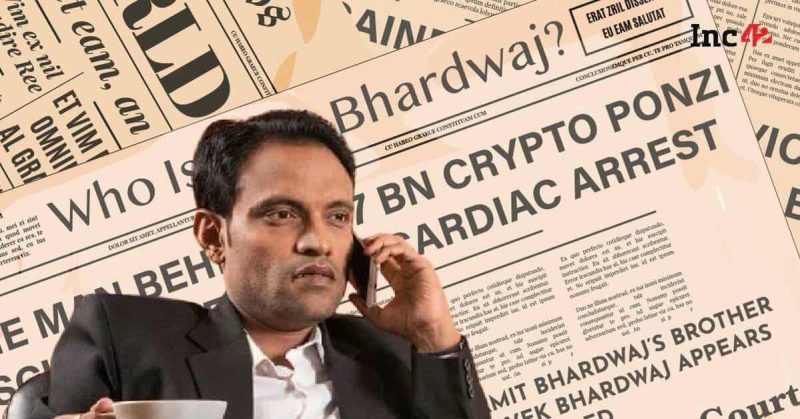
The promise of quick riches through cryptocurrency mining once masked what has evolved into one of the largest financial frauds in Indian history, known as the GainBitcoin scam. Orchestrated by Amit Bhardwaj, a convicted fraudster and businessman who died in 2022, this sophisticated Ponzi scheme exploited the nascent enthusiasm and regulatory vacuum of the early crypto market. Spanning multiple years and involving over a lakh (100,000) of investors, the scale of the alleged misappropriation is staggering, with estimates suggesting anywhere from $300 million up to 600,000 Bitcoins were collected. This analytical investigation explores the core mechanics of the fraud, the colossal consequences, and the enduring legal battles to recover the digital assets.
CASE SUMMARY: The Mirage of Cloud Mining
The GainBitcoin operation launched in 2015, positioning itself under the facade of legitimate companies such as Variabletech Pte. Ltd. and Amaze Mining and Blockchain Research Limited. The scheme’s central proposition was deceptively simple: investors were urged to purchase Bitcoin (BTC) from external exchanges and deposit it with GainBitcoin through “cloud mining contracts”.
The key incentive used to lure thousands of unsuspecting Indian investors was the promise of extraordinary returns—a guaranteed 10 per cent monthly return in Bitcoin over an 18-month contract period. Amit Bhardwaj, the alleged mastermind, also founded GB Miners, an Indian bitcoin mining pool, which was later exposed as part of the Ponzi structure. In 2017, when the operation was thriving, Bhardwaj claimed that GainBitcoin had made significant upgrades to its infrastructure and processes, citing a 47% surge in online platform transactions. He stated his vision was to allow “even the smallest investor to ride the bitcoin wave,” assuring a robust and trustworthy trading environment for the 1,00,000+ customers claimed at the time.
However, the foundation of the operation was deeply flawed, adhering to a classic multi-level marketing (MLM) structure. Payouts to existing investors were entirely dependent on the continuous inflow of fresh capital from new recruits, a defining characteristic of a pyramid scheme.
The charade began to collapse around 2017 when the influx of new capital dwindled. The true crisis was revealed when GainBitcoin, unable to sustain the promised 10% BTC payouts, unilaterally switched the terms of the contract. In an attempt to mask the immense losses, the company shifted investor payouts to an alleged in-house digital asset known as MCAP.
SCAM MECHANISM: The Deceptive Power of the MCAP Switch

The heart of the GainBitcoin fraud lay not just in its pyramid structure, but in its manipulative use of the digital currency ecosystem, exploiting investors’ lack of crypto knowledge.
The MLM Pyramid and Key Operators
The scheme was fundamentally structured as a pyramid, with Amit Bhardwaj at the apex, assisted by his brother Ajay Bhardwaj, who is also identified as a key accused. Below them were the “Seven Stars,” a group of associates who operated the multi-level marketing campaigns both in India and abroad. These agents included individuals such as Manu Sharma, Pankaj Adlakha, and Naveen Pathak.

The success of the scam depended on convincing investors that their funds were actively generating returns through “cloud mining”. While initial investors received Bitcoin payouts—creating the critical illusion of a lucrative, reliable venture—the underlying funds were allegedly being diverted. The operators collected Bitcoin from investors, but allegedly used the funds to purchase lesser-known cryptocurrencies, such as Ether and the in-house MCAP tokens, pocketing the considerable financial difference.
The Worthless MCAP Token
When the scam became unsustainable due to a slowing stream of new money, the transition to MCAP was the final act of fraud. This in-house cryptocurrency was a pre-mined token with negligible value. Crucially, the MCAP token was not generally listed on major exchanges; its primary trading venues were Bhardwaj’s own MCAP exchange and C-Cex.
This forced conversion was devastating for investors. While the value of the originally invested Bitcoin had significantly appreciated—one victim noted that the BTC price was much higher than when they initially invested—investors were suddenly holding a virtually worthless token. This maneuver allowed the masterminds to effectively retain the massive profits from Bitcoin’s appreciation while appearing to fulfill their contractual obligations with a proprietary digital substitute.
Amit Bhardwaj later offered to repay victims their initial investment amounts in Indian rupees, based on the value of Bitcoin at the time of investment. This offer was vehemently opposed by victims who demanded restitution in the current cryptocurrency value, underscoring the severity of the loss in terms of missed appreciation.
CONSEQUENCES AND LEGAL STATUS: A Multi-Agency Pursuit
The colossal scale of the scam has necessitated a complex, multi-jurisdictional legal response in India.
Financial and Victim Scope
Investigations have revealed massive financial damages. Based on recovered documents, an estimated 3,85,000 Bitcoins were collected from over 1 lakh victims. Considering the volatility and appreciation of BTC, reports suggest the total value swindled could run up to ₹6,600 crore (approximately $757 million or $800 million) or even exceed ₹1 lakh crore (a trillion rupees), depending on the Bitcoin price used for calculation.
The core accused included Amit Bhardwaj, his brothers Ajay and Vivek Bhardwaj, and their parents. Amit Bhardwaj was initially picked up in May 2018 following a complaint in Pune and was subjected to interrogation by five different states. He was arrested in March 2018 and remained in police custody until he received bail from the Supreme Court in April 2019. He tragically died of cardiac arrest in January 2022 while out on bail.
Intensified Enforcement Actions
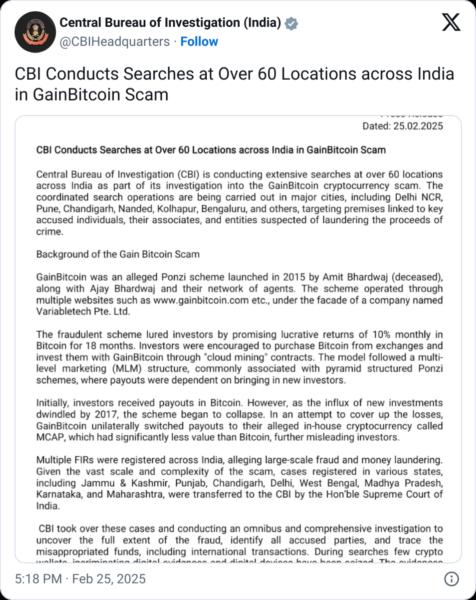
Due to the vast scale and the registration of numerous FIRs across nearly a dozen states—including Jammu & Kashmir, Punjab, Delhi, Maharashtra, and Karnataka—the Supreme Court intervened. The Court directed the consolidation of all cases and transferred the investigation to the Central Bureau of Investigation (CBI), acknowledging the operation’s expansive nature and international ramifications.
In February 2025, the CBI conducted coordinated searches at 60 locations across multiple cities, including Delhi NCR, Pune, Bengaluru, and Chandigarh, targeting the key accused and their associates involved in laundering the illicit gains. During these raids, the CBI seized virtual digital assets worth approximately ₹23.94 crore (about $2.8 million). Furthermore, authorities secured crucial evidence, including multiple hardware crypto wallets, 121 documents, 34 laptops, and email/instant messaging application dumps.
Concurrently, the Enforcement Directorate (ED) is pursuing money-laundering charges under the Prevention of Money Laundering Act (PMLA). The ED’s investigation has led to the attachment of properties totaling INR 69 Cr. The ED has also scrutinized at least nine overseas firms in locations like Hong Kong, Dubai, and Estonia, used to divert the crime proceeds. In December 2023, the ED arrested Simpy Bhardwaj, Ajay Bhardwaj’s wife, alleging she actively participated in soliciting investments and concealing the proceeds of crime. The Supreme Court previously directed Ajay Bhardwaj to disclose the access details, including usernames and passwords, for his cryptocurrency wallets, which were deemed crucial for tracing the full scale of the misappropriated funds.
WARNING SIGNS (RED FLAGS) FOR INVESTORS

The GainBitcoin case provides a crucial template for identifying cryptocurrency scams, which often hide behind jargon like “cloud mining” or “blockchain technology”.
- Guaranteed, Unrealistic Returns: The core promise of 10% monthly returns in Bitcoin for 18 months should immediately trigger alarm. In volatile markets like cryptocurrency, any scheme guaranteeing high, fixed returns regardless of market performance is unsustainable and signals a Ponzi structure.
- Reliance on Recruitment (MLM/Pyramid Scheme): The operational model relied on bringing in new investors to fund payouts for old ones. True investment platforms derive profits from trading, mining, or value creation, not solely from recruitment commissions.
- Lack of Transparency and Contradictory Statements: Amit Bhardwaj initially denied involvement in GainBitcoin, later backtracking and labeling the denial a “PR strategy”. He also admitted to inflating the investment figures shown on the company website. Contradictions from leadership regarding business operations are significant red flags.
- Unilateral Switching of Assets: The sudden, unannounced change in payout currency from high-value Bitcoin to the virtually worthless, proprietary MCAP token indicated that the business model had failed and that the operators were attempting to shield themselves by dumping a liability onto the investors.
- Exploitation of Knowledge Gap: The perpetrators targeted investors with a limited understanding of cryptocurrency technology, using complex-sounding terms like “cloud mining” to obscure the reality of a simple cash-funneling operation.
WRITER’S COMMENTARY: The Echo Chamber of Hype
The success of the GainBitcoin fraud, despite offering returns that were transparently “too good to be true”, can be traced back to two fundamental failures: the hyper-sustainability of unwarranted belief and the critical absence of regulatory clarity in the frontier stage of decentralized finance.
Core Cause Assessment
The scam thrived primarily because the founders effectively weaponized the promise of the technology rather than the reliability of the business model. In the early days of cryptocurrency adoption (2015-2017), Bitcoin was shrouded in an atmosphere of explosive, unpredictable growth and complexity, making claims of “cloud mining” sound authoritative and impenetrable to the lay investor. Amit Bhardwaj’s claimed vision to get “even the smallest investor to ride the bitcoin wave” was not a financial strategy but a psychological one, tapping directly into the fear of missing out (FOMO) and the cultural appetite for multi-level marketing structures prevalent in many emerging economies. When returns were initially paid in BTC, this validated the illusion of profitability, reinforcing the system through social proof before the inevitable conversion to the worthless MCAP token occurred. The core cause of success was a perfect storm of technical opacity meeting unchecked greed and regulatory inertia.
Proposals for Prevention
To mitigate the risk of future, scaled crypto Ponzi schemes, focused intervention is required:
- Mandatory Regulatory Sandboxes for High-Yield Products: Financial regulators must establish “crypto-yield sandboxes.” Any scheme promising returns exceeding standard market benchmarks (e.g., 5-10% APR) must be required to prove, in a transparent and auditable manner, the underlying source of its profitability (e.g., hash rate reports for mining, verified trading strategies) before soliciting public funds. This shifts the burden of proof onto the promoter.
- Custodian Disclosure Requirements (CDRs): Companies accepting deposits of blue-chip crypto assets (like BTC or ETH) should be legally mandated to disclose the addresses of their cold storage wallets to a designated third-party escrow service or regulator. This would prevent the illicit, unilateral switching of high-value assets (like BTC) for proprietary, worthless tokens (like MCAP).
- Financial Literacy Focused on Decentralization: Given that many victims lacked fundamental crypto knowledge, governments and industry bodies must fund robust, accessible public education campaigns focusing on the core concept that decentralization implies due diligence. If a promised return is centrally controlled and cannot be independently verified on the blockchain, it carries exponentially higher risk.
The GainBitcoin saga, currently being unraveled by the comprehensive, country-wide investigation led by the CBI and ED, serves as a chilling case study. Like an elaborate digital labyrinth where the promised treasure (Bitcoin) was swapped for fool’s gold (MCAP), the investigation seeks to trace the hundreds of thousands of stolen Bitcoins that may have crossed international borders. For the crypto-interested public, this decade-old scam is a reminder that in the world of decentralized finance, skepticism remains the most reliable currency.
REFERENCES
- wikipedia – Amit Bhardwaj
- coingeek – Alleged GainBitcoin scam kingpin offers to repay investors in Indian rupees
- inc42 – GainBitcoin Scam: Alleged Mastermind’s Wife Falls In ED’s Trap As Multi-Agency Pursuit Intensifies
- varindia – GainBitcoin Scam: 3,85,000 Bitcoins were collected from over one lakh victims
- tradingview – India chases decade-old Bitcoin scam with nationwide raids