


The story of Freeway began with a promise of democratization in a market defined by gatekeepers. Originally established in 2017 under the name AuBit, the project initially struggled before being rebooted in early 2021 as a high-yield crypto staking and trading platform. Managed by a core group of UK residents including Graham Doggart, Sadie Hutton, and Mark Kearns, Freeway positioned itself not as a risky “degen” protocol, but as a bridge to institutional-grade returns for the average person.
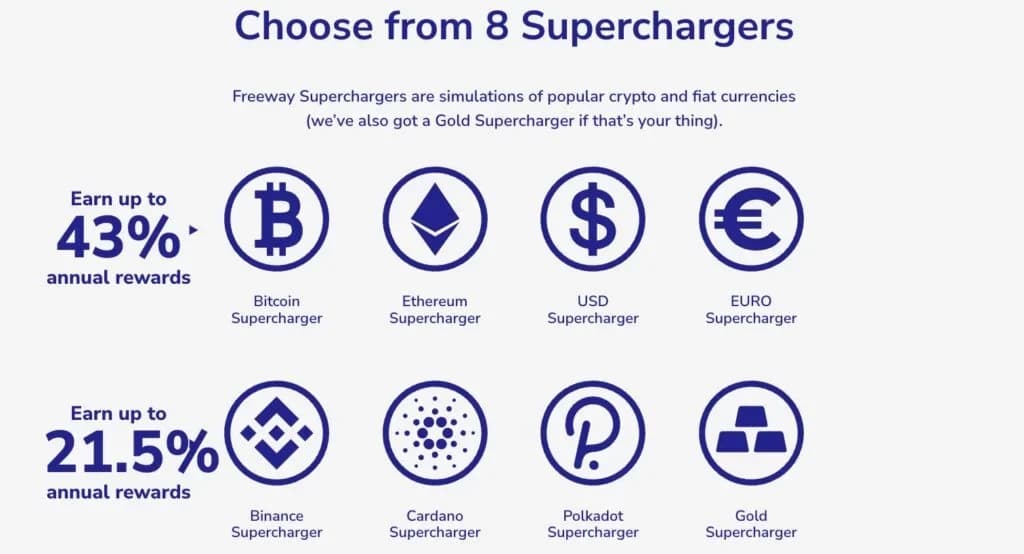
At the heart of the hype was the “Supercharger” product. Freeway marketed these as a way to earn astronomical annual percentage yields (APY) of up to 43% on deposits of both fiat and cryptocurrency. The platform’s marketing leaned heavily on a “social finance mission,” claiming that 80% of all platform revenue was redistributed back to users. With an “access for all” philosophy that allowed a minimum investment of just $1, the platform successfully lured over 5,000 retail investors who believed they had found a safe harbor in the volatile crypto storm.

The Peak: The Veneer of Legitimacy
By 2022, Freeway appeared to be a dominant player in the crypto-lending space, claiming to have processed more than $161 million in value. To maintain this growth, the platform utilized its native utility token, FWT (Freeway Token), which served as a catalyst for rewards. Users were told that holding FWT was necessary to “activate” the highest reward tiers and that their funds were held in segregated bank accounts with regulated EU brokerages.
The leadership team was “doxxed,” frequently appearing in marketing videos to celebrate “positive growth”. In October 2022, Sadie Hutton even boasted that $1 million had been invested into Freeway in a single week. This air of “TradFiesque legitimacy” was the platform’s greatest weapon, convincing users that their investments were “never put at risk” and were “safer than most bank accounts”.
The Crash: A Sunday Night Shutdown
The illusion of stability evaporated on Sunday, October 23, 2022. Without warning, Freeway posted a notice on its website and Twitter (now X) announcing a total halt on withdrawal services. The company blamed the freeze on “unprecedented volatility” in Foreign Exchange and cryptocurrency markets, claiming it needed to “diversify its asset base” for long-term sustainability.
The fallout was catastrophic. The FWT token, which had already plummeted the previous day, crashed by over 80% within hours. As panic set in, investors noticed a disturbing trend: the Freeway website was actively scrubbing the names and photos of its executives and removing its “Our partners” section. Prominent crypto investigator FatManTerra had warned just a day earlier that the platform was likely a Ponzi scheme, but for most, the warning came too late. Communication channels were shuttered, leaving thousands of users staring at frozen dashboards and “simulated” rewards that they could no longer access.

Deep Fraud Mechanism: The “Virtual” Shell Game
As investigators untangled the wreckage, they discovered that the “Superchargers” were not what they seemed. According to the platform’s own fine print, Superchargers were merely “virtual simulations” of popular currencies that carried “no financial entitlements” and were not obligated to be redeemed or exchanged by Freeway. They were closed-loop tokens that existed only within the Freeway ecosystem—essentially “monopoly money”.
The most damning revelation came through subsequent court filings. While Freeway promised that funds were held in segregated accounts for users, the reality was a pooled brokerage account at a Greek firm called Ardu Prime. Customer funds were aggregated into an institutional account in AuBit’s own name, rather than the investors’ names.
AuBit then used these pooled assets as collateral to obtain massive lines of credit—as high as $130 million—to fund its own “quant strategies” and leveraged trading. When the platform cited “trading losses” for the withdrawal halt, it essentially admitted that it had gambled with customer deposits and lost. Furthermore, Ardu Prime itself became embroiled in legal trouble, with Greek authorities eventually suspending its license.
Red Flags: The Warning Signs in Retrospect
In hindsight, the path to $160 million in losses was paved with significant red flags:
- The 43% APY: Offering nearly 50% returns on stable assets like USD or EUR is mathematically inconsistent with legitimate market yields.
- The “Simulation” Clause: The legal disclaimer that tokens “create no financial entitlements” provided a built-in exit strategy for the operators.
- Complex Corporate Structure: Freeway and its parent, AuBit, operated through a “confusing knot” of entities in the Seychelles, Cayman Islands, UK, and Wyoming.
- Opaque Revenue: The platform never clearly explained how it generated profits, referring to its “quant strategies” as a “mystery”.
- Delayed Withdrawals: Large withdrawals were reportedly being “delayed” shortly before the total freeze.
Legal Aftermath: Liquidation and Winding Up
The legal battle moved to the Cayman Islands Grand Court. In late 2023, Judge David Doyle dismissed AuBit’s attempt to restructure the company under a new brand called ThriveFi. The judge noted a “genuine lack of proper accounting records” and ruled that the company’s affairs required a “thorough and independent investigation”.
On October 19, 2023, the court ordered the mandatory liquidation of AuBit International. Independent liquidators from the firm FFP were appointed to oversee the dissolution. Richard Murphy, a senior manager at FFP, informed account holders that upwards of $150 million appeared to be “missing,” having been dissipated by various parties. While the liquidators are tasked with recovering assets, creditors like the group LedgerScore—who filed a lawsuit in Wyoming—face a long, difficult road to recovery. Today, Freeway stands as a “cautionary tale” in the crypto-lending sector, a field already littered with the wreckage of similar ventures like Celsius.
WRITER’S COMMENTARY
The success of the Freeway scam rested on a singular, brilliant technical loophole: the “Supercharger simulation.” By legally defining their products as “simulations” rather than financial instruments, the founders created a closed-loop system where they could print fictional yield on a dashboard while simultaneously treating real user deposits as their own leveraged trading capital.
Psychologically, the scam exploited the “TradFi Trust Trap.” By using terms like “segregated accounts,” “EU-regulated brokerages,” and “doxxed teams,” Freeway manufactured a sense of institutional safety that lowered the guard of even cautious investors. They didn’t just sell high yield; they sold the feeling of a regulated bank. The tragedy of Freeway is that the “unprecedented volatility” the team blamed was merely the inevitable result of using customer money as collateral for high-stakes gambling. In this ecosystem, the users weren’t the customers—they were the involuntary underwriters of a $160 million failed hedge fund, disguised as a “social finance” revolution. Tone: Investigative and sharp.

