
The cryptocurrency boom of the early 2020s promised financial liberation through decentralized applications (DeFi). But while proponents championed “trustless” technology, sophisticated scammers leveraged the same principles to create hyper-efficient fraud machines. At the center of this paradigm shift was Forsage, a platform that branded itself as an “international crowdfunding” opportunity and a legitimate, low-risk investment, yet was systematically designed to siphon an estimated $340 million from millions of retail investors globally.
This investigation conducts a forensic deep dive into the architecture of Forsage, analyzing how its creators transformed a classic pyramid scheme into an automated, blockchain-based financial weapon, detailing the staggering financial damage, the inherent technical red flags, and the subsequent global legal crackdown.
Technical Mechanism and The Psychology of Trust
Forsage, launched in January 2020, operated across the Ethereum, Tron, and Binance Smart Chain (BNB Chain) blockchains. Its promoters advertised the platform as a system that promised 100% transparency, complete decentralization, peer-to-peer transactions, and zero risk—claims that were demonstrably false.

The core deception lay in wrapping a textbook Ponzi and pyramid scheme inside “immutable” smart contract code.
“Fraudsters cannot circumvent the federal securities laws by focusing their schemes on smart contracts and blockchains.”
The Smart Contract Lie
A smart contract is a self-executing computer program stored on a blockchain that automates digital asset transactions. Forsage leveraged this perceived “trustless” nature to lure users, claiming that because the contract code was public, it could not be a scam.
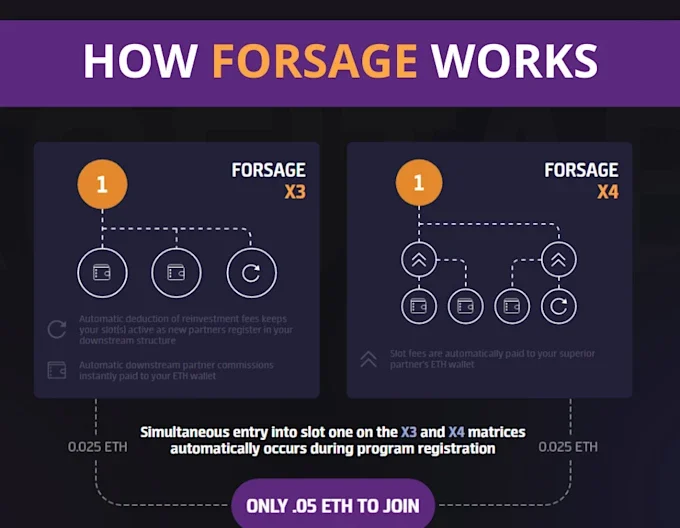
However, forensic analysis revealed that the complexity of the source code acted as an obfuscation layer. The underlying code systematized a combined Ponzi and pyramid structure:
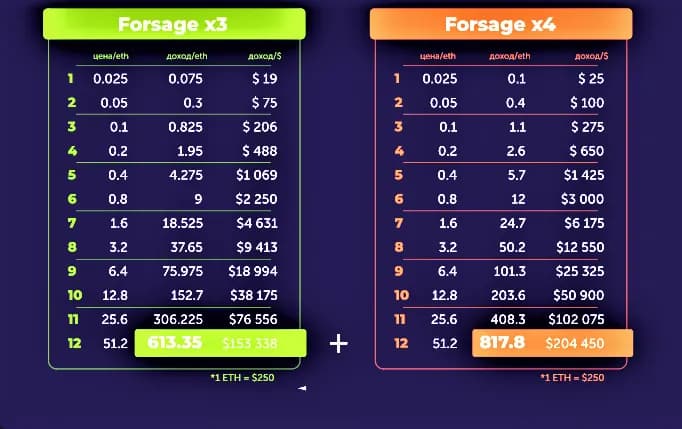
- Pyramid Mechanics (Recruitment): The primary way for investors to earn profits was through recruiting others into the operation. Users received a referral code, creating pyramids—or “teams”—with funds flowing upwards. Forsage utilized two matrix systems, X3 and X4, where users purchased “slots” at escalating costs to participate and unlock higher earning potential.
- Ponzi Mechanics (New Money Pays Old): Consistent with a Ponzi scheme, the smart contract was coded to automatically divert the funds from new investors to pay earlier participants as soon as a new user purchased a slot.
- Owner Enrichment: Despite promises of 100% income going to members, the founders deliberately included code that paid out a portion of investor funds to cryptocurrency wallets they controlled, siphoning money outside the system. The contract was specifically initialized so the owner account had all matrix slots opened for free and could never become blocked, ensuring ample opportunities for profit.
The High Cost of Automated Fraud
The internal structure of Forsage made continued recruitment and investment mandatory for profit. The maximum investment for all slots in one matrix was 51.2 ETH, and users were heavily incentivized to “reinvest” by buying new levels to prevent their existing slots from becoming “blocked,” which would forfeit future earnings.
Crucially, operating this complex, on-chain mechanism was expensive for users. Forsage transactions consumed far more computational resources, known as “gas,” than most other Ethereum transactions. The complexity required heavy use of the costly SLOAD and SSTORE EVM operations. As a result, Forsage users, on average, paid more than four times as much in transaction fees compared to other smart contract users, compounding their overall losses.
Financial Analysis: Quantifying the Global Loss
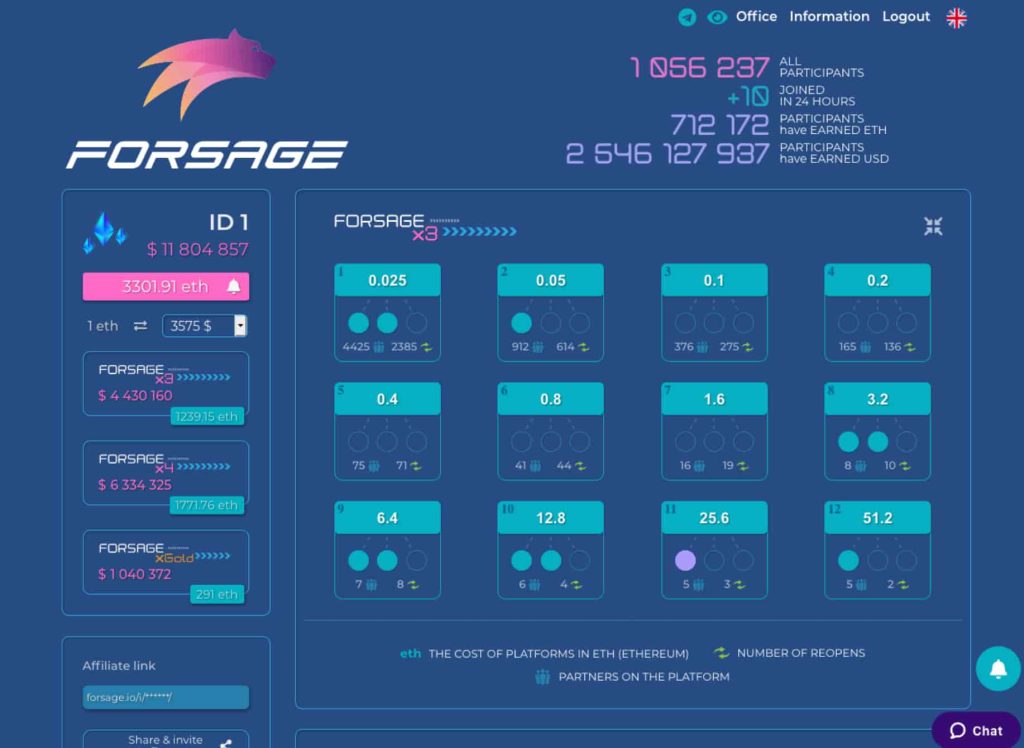
The sheer scale and efficiency of Forsage’s automated fraud were staggering. Over the course of its operation, millions of retail investors participated. Data analysis of the Ethereum Matrix contract alone, spanning January 2020 to January 2021, documented the flow of 721,000 ETH, which amounted to $225 million USD at the time of calculation.
The 88% Failure Rate
Forensic research quantified the outcome for investors, yielding a definitive characteristic of a pyramid scheme: The vast majority of participants lost money.
- Losses: Over 88% of the 1.04 million Ethereum addresses that interacted with the ETH Matrix scheme incurred a net loss. Collectively, these accounts lost 305,785 ETH.
- Zero Payouts: Court documents and blockchain analyses confirmed that over 50% of investors never received any payment or return.
- Gains Concentration: The profits were highly concentrated at the top. The most profitable user—the contract owner—earned 5,409.6 ETH (over $1.2 million USD in early valuations). The top 1,000 users of the platform captured 50% of the total profits.
This concentration demonstrates how the system was mathematically tilted: the more levels an investor purchased, the more profitable they generally were, reinforcing the advantage of early adopters and sophisticated operators.
The Red Flags That Defined the Scam
Forsage’s methods utilized aggressive psychological manipulation intertwined with typical scam indicators, particularly targeting economically vulnerable populations in emerging markets. Regions like Nigeria, the Philippines, Venezuela, and India saw particularly high concentrations of users.
The founders and promoters, including U.S.-based influencers known as the “Crypto Crusaders,” aggressively pushed the scheme across social media platforms like Facebook, YouTube, and Telegram.
Key Warning Signs Promoters Used:
- False Prosperity Claims: Videos and posts promised “life changing money,” “unlimited income,” and the ability to earn thousands of dollars without recruiting others. One promoter claimed to have turned a $1,600 investment into $1 million in seven months.
- Technical Deception: Promoters repeatedly used the decentralized, open-source nature of the smart contracts to falsely claim Forsage was “scam-proof” and guaranteed “the purity of conditions”.
- Impersonation and Poor Quality: An account impersonating Paga, a legitimate African financial services company, was used on Facebook to promote Forsage, often featuring a link to a WhatsApp account—a common tactic for online investment scams. Other red flags included poorly written messages and a lack of registered businesses like “Forsage Investment” in Nigeria.
The Founder’s Persistent Fraud

The principal founder, Vladimir “Lado” Okhotnikov, displayed an alarming ability to pivot and relaunch identical schemes, demonstrating perpetual fraudulent intent. While Forsage was collapsing under regulatory pressure, Okhotnikov was linked to subsequent, structurally similar schemes like Meta Force and Meta Whale. Experts examining Meta Whale found that although the contracts were different from Forsage, the structure remained almost identical, and the use of proxy contracts suggested the scheme was potentially set up for a “rug pull” by redirecting funds. Okhotnikov also attempted to use high-profile stunts, such as directing a film starring Kevin Spacey, written by Okhotnikov himself, to bolster his reputation and attract users to his latest ventures, including the Holiverse metaverse startup.
Legal Status and Regulatory Crackdown
Forsage’s massive, aggressive, and transnational operation drew swift action from global regulators, establishing key legal precedents for DeFi fraud.

U.S. Enforcement Actions
The U.S. government pursued both civil and criminal actions:
- SEC Charges (Civil): In August 2022, the U.S. Securities and Exchange Commission (SEC) charged 11 individuals, including the four founders, for creating and promoting the scheme. The SEC explicitly branded Forsage as a “textbook pyramid and Ponzi scheme”. Two U.S.-based promoters later agreed to settle the charges without admitting or denying the allegations, agreeing to pay disgorgement and penalties.
- DOJ Indictment (Criminal): In February 2023, a Federal grand jury in the District of Oregon indicted the four Russian national founders—Vladimir Okhotnikov, Olena Oblamska, Mikhail Sergeev, and Sergey Maslakov—on charges of conspiracy to commit wire fraud. The Department of Justice touted this as the first criminal fraud case in U.S. history involving a DeFi Ponzi scheme. If convicted, the founders face a maximum sentence of 20 years in prison.
Global Regulatory Defiance
Forsage systematically defied early cease-and-desist orders issued by foreign regulators, asserting that its decentralized nature placed it beyond their reach.
- Philippines: The Philippine Securities and Exchange Commission (SEC) issued a warning in June 2020 and later a formal cease-and-desist order in September 2020, labeling Forsage an unregistered investment scheme that resembled a Ponzi scheme. Forsage refused to comply.
- Montana: The Montana Commissioner of Securities and Insurance issued a cease-and-desist order against Forsage in March 2021 after receiving investor complaints.
- Russia and Georgia: Authorities in Russia warned that later Okhotnikov schemes like Meta Force resembled a “financial pyramid”. Okhotnikov, who fled to Dubai, was convicted in absentia in Tbilisi, Georgia, for laundering $1.1 million in Forsage proceeds and now faces an international arrest warrant.
Despite these significant legal actions and the confirmation that over 80% of investors lost money, Forsage’s website and promotional channels continued to operate even after the indictments.
Writer’s Commentary
The catastrophic success of Forsage hinged not merely on greedy promises, but on the exploitation of a fundamental asymmetry of knowledge inherent to early blockchain adoption. Forsage’s founders, drawing on prior expertise in multi-level marketing (MLM), masterfully conflated technical visibility with financial transparency. They weaponized the nascent trust surrounding “decentralization” and “smart contracts,” convincing novice retail investors that an automated system was, by definition, “scam-proof”.
The reality was that the smart contract’s code was computationally expensive and intellectually opaque, requiring weeks of expert analysis to deconstruct its fund-diverting, pyramid-sustaining logic. The public availability of the code, lauded as a security feature, became the ultimate psychological defense, serving as a layer of forensic complexity that allowed founders to systematically defraud millions while claiming technical purity. The scam’s triumph was achieved by programming a complex, automated lie that successfully leveraged the victims’ technological illiteracy under the guise of financial innovation.